Book pacing and why it matters
Pacing is the speed at which a story moves — the rhythm of tension and release, action and reflection, acceleration and stillness that controls how a reader experiences time within a narrative. It is not simply about writing fast or slow scenes. It is about knowing when to push forward and when to breathe, when to withhold and when to deliver, and how to calibrate the reader's emotional state so that every significant moment lands with the weight it deserves.
In practice, pacing is controlled through a combination of scene length, sentence structure, chapter breaks, the ratio of action to interiority, and the strategic management of information. Short sentences accelerate. Long, subordinate-clause-heavy sentences slow the reader down and create space for atmosphere and thought. Short chapters — a technique used to tremendous effect in thriller-adjacent fantasy — create a compulsive forward momentum, because the end of a chapter is always close enough to make "just one more" feel achievable. Long chapters immerse the reader more deeply but require more internal variation to sustain engagement.
Fantasy presents particular pacing challenges precisely because of the demands of world building. The information a reader needs to understand the world — the history, the magic system, the political structures, the geography — must be delivered somewhere. The temptation is to deliver it in dedicated expository passages, which almost always kills pace. The craft solution is to weave necessary information into scenes that are already doing other narrative work: a character learns the rules of the magic system under pressure, in a situation where the stakes of not understanding are immediate. The world building arrives as part of the action, not instead of it.
Romantasy has its own distinctive pacing demands, centred on the management of romantic tension. The reader wants the central relationship to develop — but not too quickly. The pleasure of a romantasy is significantly located in the delayed gratification of a relationship that is clearly inevitable but not yet realised. Pacing in romantasy is therefore the art of slowing down the very thing the reader most wants to happen, while ensuring that the delay feels earned rather than artificial.
Science fiction pacing is often tied to the revelation of information about the central premise. The best science fiction parcels out its ideas at the rate a reader can absorb and process them, building understanding incrementally so that when the full implications of the premise are finally clear, the reader feels the weight of them completely. Rushing this process produces confusion. Prolonging it produces impatience. The pacing of a science fiction novel is, in significant part, the pacing of an argument.
Dark academia tends toward a slower, more atmospheric register — the prose is often dense, the interiority rich, the sensory detail of place and season and institution lovingly rendered. This is not slow pacing in a negative sense. It is the deliberate construction of an immersive world that the reader is meant to inhabit rather than race through. But even in dark academia, pace must vary. The moments of revelation, transgression, or collapse must arrive with a different rhythm from the long, languid build that precedes them — otherwise nothing feels like a climax because everything feels equally weighted.
Every scene should be moving something: the plot, the relationship, the character's internal state, the reader's understanding of the world. When nothing is moving, the pace is not slow. It is stalled.
Pace is the heartbeat of a story. Learn to write it well, and you will hopefully be able to keep your reader’s up all night reading your books.
Most commercially successful novels follow a similar pacing rhythm. Whether you're writing fantasy, literary fiction, romance, thriller, or sci-fi, the emotional highs and lows tend to occur at roughly the same points.

Deep dive on pacing patterns
Here's a structural breakdown based on the most common frameworks (Three-Act Structure, Hero's Journey, Save the Cat!, Story Grid, and classic dramatic structure).
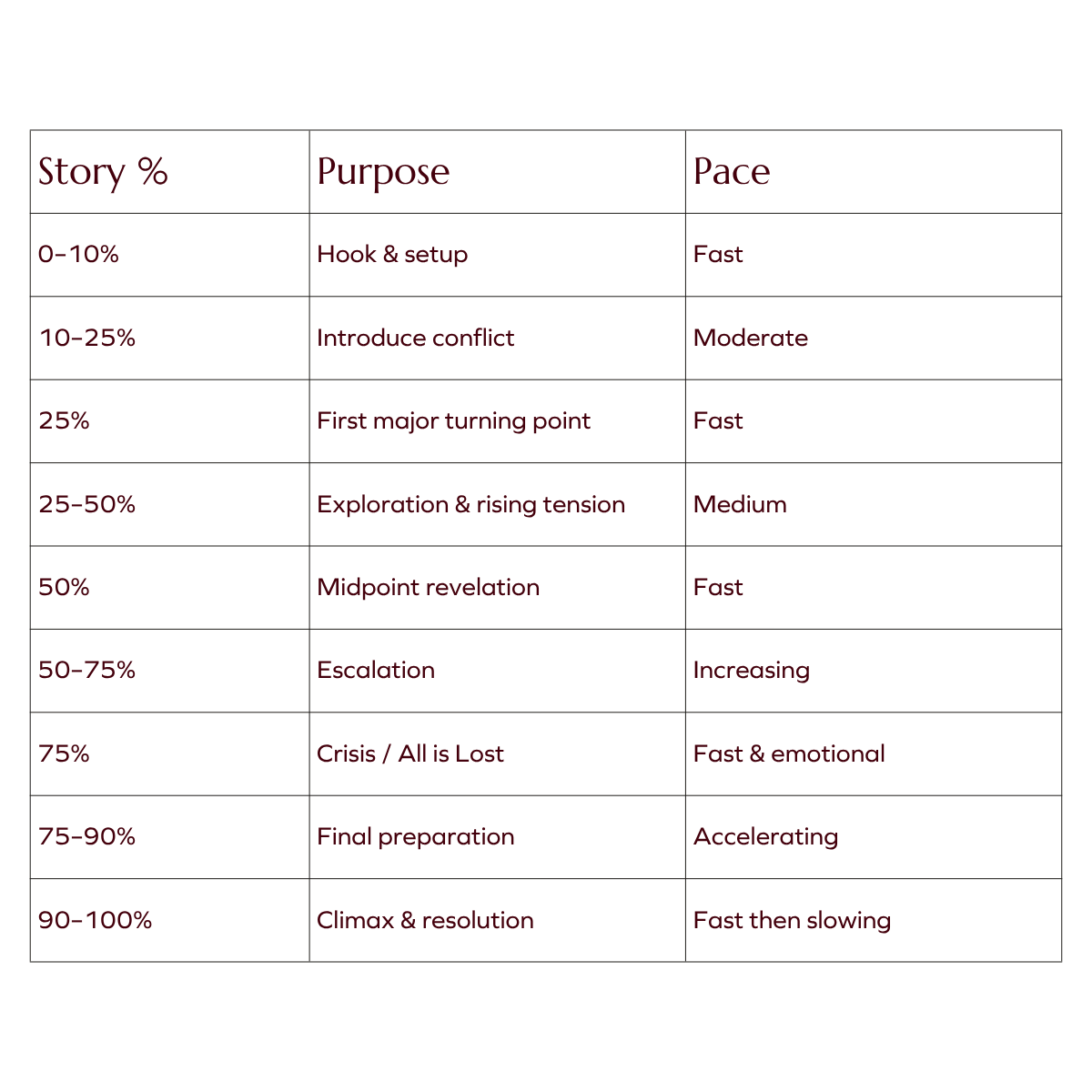
1. Opening (0–10%)
Goal
Capture attention immediately.
Introduce protagonist.
Establish tone.
Hint at central conflict.
Give readers questions they want answered.
Reader should be asking
Who is this?
Why should I care?
What is unusual?
Pacing
Fast.
Little exposition.
Lots of intrigue.
2. Setup (10–25%)
Introduce:
Supporting cast
Setting
Rules of the world
Character flaws
Character desires
Stakes
The protagonist still has one foot in their "normal" life.
This is where readers become emotionally invested.
3. Inciting Incident (around 10–15%)
Something changes that cannot be ignored.
Examples:
Murder
Discovery
Invitation
Betrayal
Monster attack
Love interest appears
The protagonist may initially resist.
4. First Plot Point (around 25%)
This is one of the biggest moments.
The protagonist commits.
Examples:
Leaves home
Accepts mission
Falls into danger
Declares war
Starts investigation
There is no returning to normal life.
The story truly begins here.
5. Rising Action (25–50%)
This is often the largest section.
Contains:
Obstacles
Character development
Relationships
Small victories
Small failures
Learning the world
The conflict should continually become more difficult.
A common rhythm is:
Challenge
Success
Bigger challenge
Failure
New information
Temporary victory
Readers should feel momentum.
6. Midpoint (50%)
Often called the "point of no return."
Usually one of:
Huge victory
Huge defeat
Massive revelation
Character transformation
Stakes dramatically increase
Everything changes.
The protagonist often shifts from reacting to actively driving events.
7. Escalation (50–75%)
Pressure increases.
Things begin falling apart.
Friends may:
leave
betray
die
fail
Resources become limited.
The antagonist becomes stronger.
Every chapter should feel more dangerous than the last.
8. Crisis / All Is Lost (around 75%)
The emotional low point.
The protagonist believes they have failed.
Often includes:
Death
Betrayal
Capture
Loss
Sacrifice
Readers should genuinely wonder how victory is possible.
9. Dark Night of the Soul (75–85%)
A quieter section.
The protagonist reflects.
Learns the final lesson.
Accepts who they truly are.
This emotional pause gives the climax greater impact.
10. Climax (90–98%)
Everything comes together.
Major promises are fulfilled.
Questions are answered.
Character growth is tested.
The protagonist wins—or loses—because of who they have become, not because of luck.
11. Resolution (98–100%)
Slow the pace.
Show:
Consequences
Character futures
New normal
Emotional closure
Leave readers satisfied.
Emotional pacing
A common pacing pattern looks something like this:
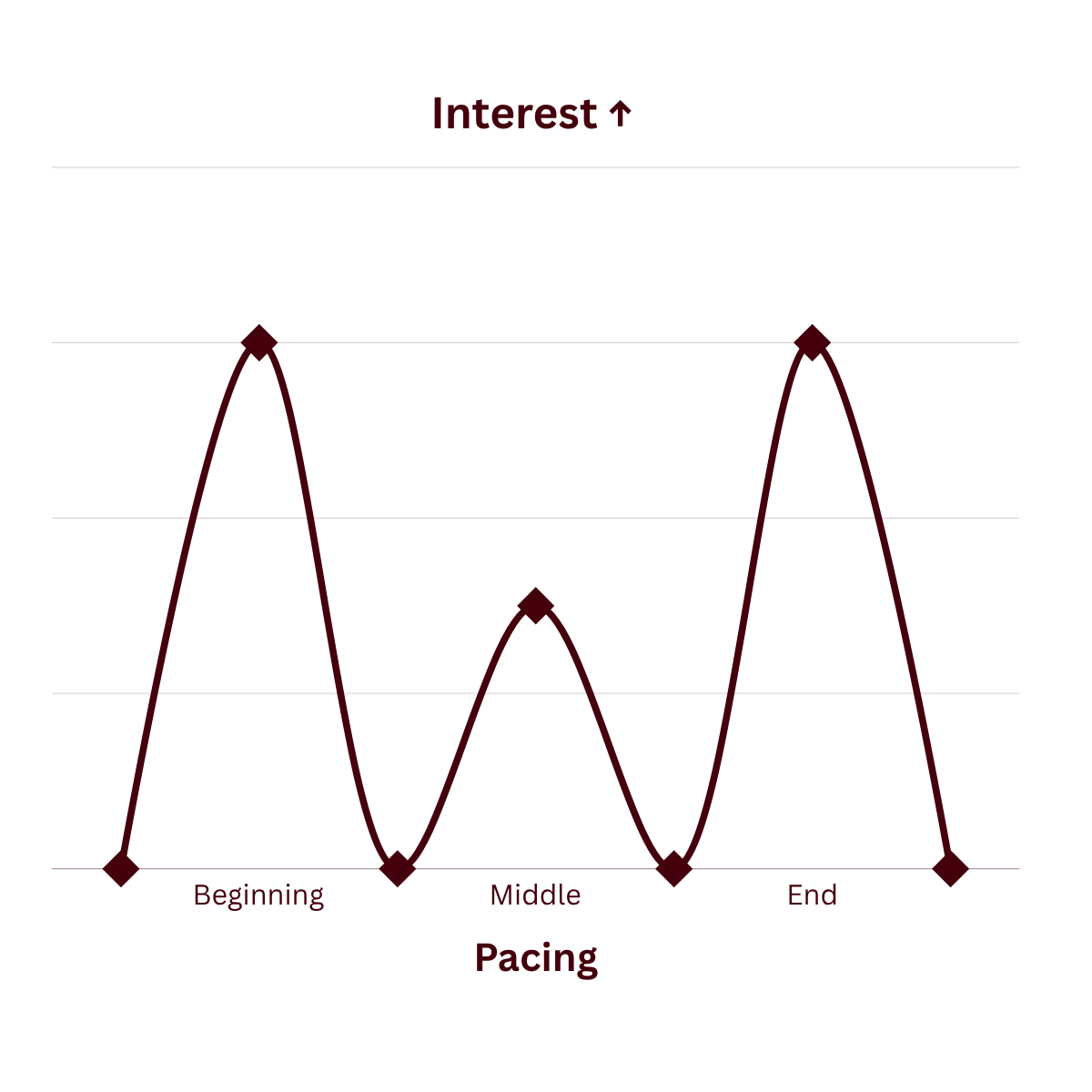
You don't want a constant climb. Stories feel more engaging when they alternate between tension and release:
Action — reflection
Victory — setback
Hope — despair
Discovery — complication
But at the end of the day, it’s your book. If you want a constant climb, where the story reaches a crescendo and then crashes dramatically, or prefer a more even worm, the choice is yours. I’m just giving you a base pacing structure to work from. I would advise you to research pacing patterns and read some of your favourite books and note down the pacing pattern, as a cathartic exercise.
In many popular fantasy books the characters are constantly and physically running. For example; The Lord of the Rings and more recently, Starside by Alex Aster. The constant running makes the reflective sections hit better, and makes for an exciting read. If you’re stuck with pacing issues, consider reading some Tolkien or Aster to see how you can adjust your pacing. Or, you could simply have your characters running, and possibly fighting, through the chapters to build momentum.
Chapter pacing
Many successful novels follow a repeating cycle:
Goal
Conflict
Complication
Decision
New goal
Each chapter should end with one of the following:
a new question
a surprise
a revelation
a difficult decision
a looming threat
This gives readers a reason to keep turning pages.
Scene pacing
Within each scene, a useful structure is:
Purpose – What does the character want?
Conflict – What's stopping them?
Outcome – Success, failure, or partial success.
Consequence – How does this change the story?
Hook – What makes the reader continue?
If a scene doesn't change something—plot, character, relationships, or stakes—it may not need to be there.
Overall pacing by genre
Different genres tend to stretch or compress parts of this structure:
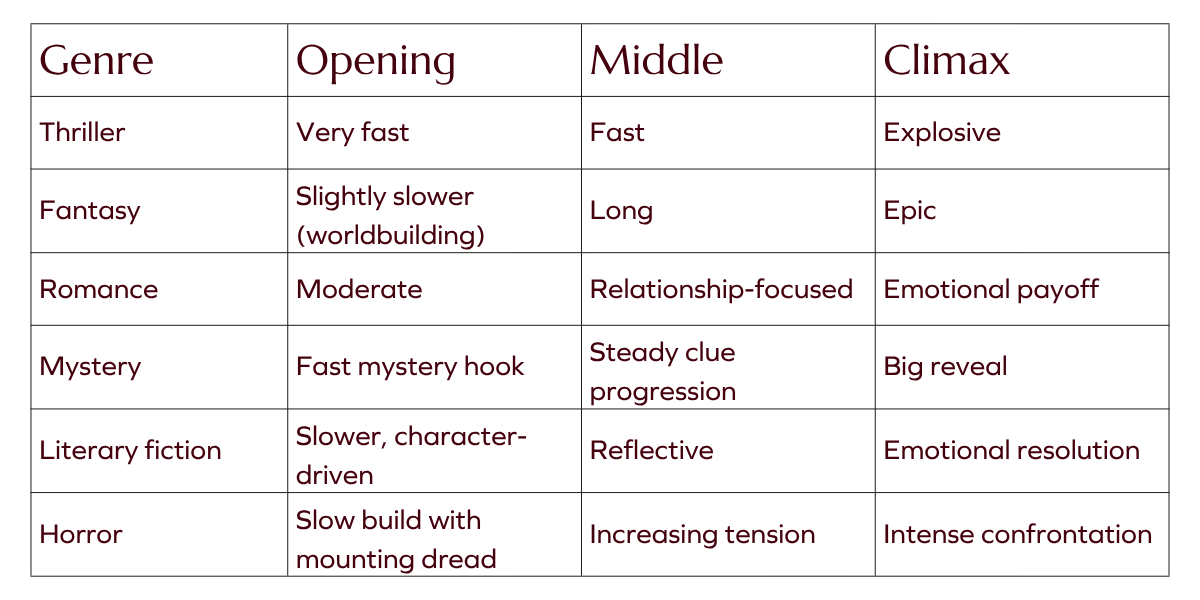
In conclusion
The key takeaway is that pacing isn't about constant speed—it's about controlling tension. The strongest novels continually raise questions, deepen emotional investment, and increase the consequences of failure, while giving readers brief moments to breathe before the next escalation.