
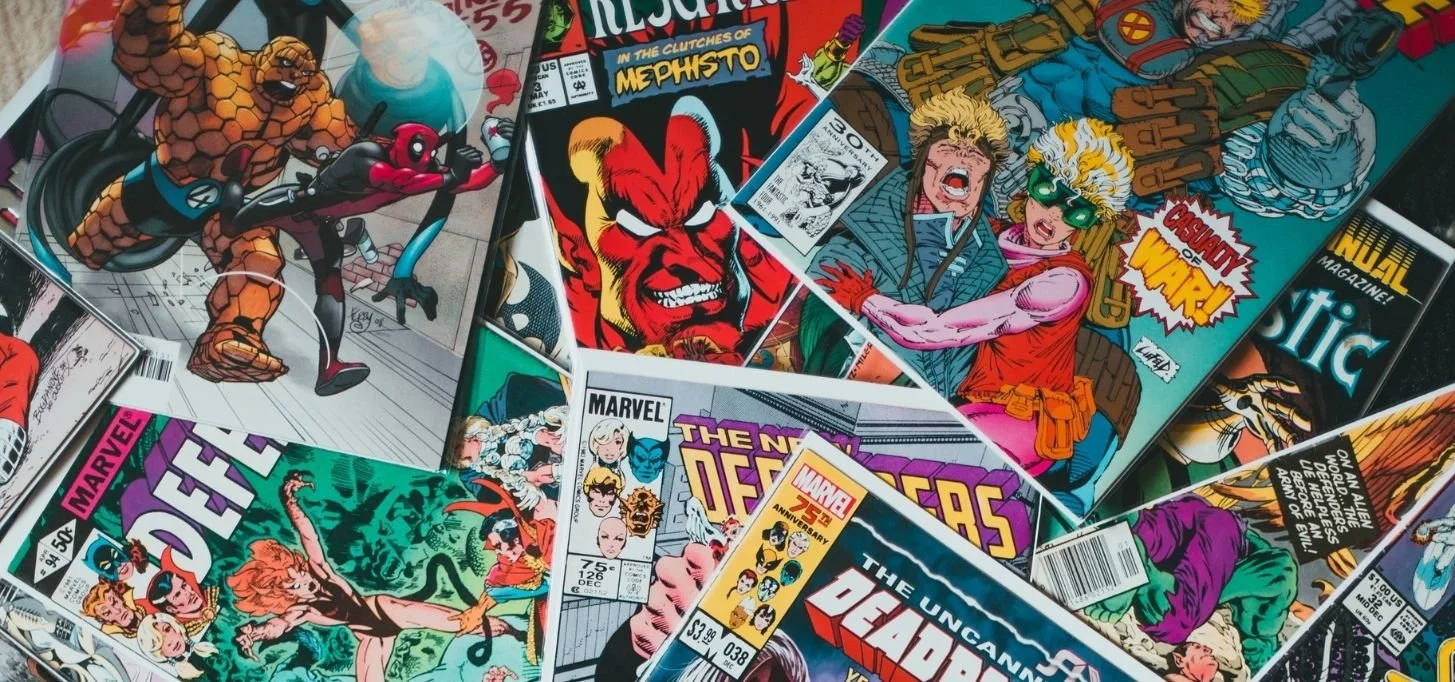
Editing graphic novels & comics
Make sure your words match the graphics
A graphic novel or comic has to work on the page, not just in the script.
The dialogue needs to sound right. The pacing needs to work from panel to panel. The page turn needs to earn its place. The visual storytelling needs room to breathe.
And sometimes the problem isn't the writing at all.
Fae Media edits graphic novels, comics and illustrated sequential storytelling, helping writers strengthen the story while keeping the relationship between words and images firmly in view.
Because a comic isn't a novel with pictures.
It's its own beast.
Before you send your comic to an editor, look at the page
Graphic storytelling has its own set of problems. A script can read beautifully and still become unwieldy once it's broken into panels.
Ask yourself:
Does every panel need to be there?
A panel should be doing something.
Moving the story forward. Revealing character. Establishing a setting. Creating tension. Delivering a joke. Changing what the reader understands.
If you can remove a panel without changing anything, it might not need to be there.
Are you showing or telling?
This is one of the oldest rules in storytelling, and it's particularly important here.
If the artwork already shows a character crying, you probably don't need dialogue explaining that they're sad.
Give the artist something to work with.
Does the page turn do anything?
The page turn is one of the most useful tools in sequential storytelling.
A reveal, a joke, a shock, a change of location or a moment of silence can all become more effective when you understand where the reader will encounter them.
Can the reader follow the action?
Fight scenes, chase scenes, crowd scenes and rapid changes in location can become confusing very quickly.
Read through the sequence without worrying about the prose.
Can you tell who is where, what they're doing and what has changed?
Is there enough room for the art?
A script can become so prescriptive that there's no space left for the artist to interpret it.
Unless you're writing and illustrating the entire book yourself, remember that you're creating a blueprint for another person to work from.
Does the dialogue sound like speech?
People rarely talk in perfectly constructed paragraphs.
Dialogue needs to fit the character, the situation and the space available on the page.
And unlike a novel, you've got a very real limit on how much dialogue can physically fit inside a speech balloon.
What kind of comic editing do you need?
Developmental editing
Developmental editing looks at the story as a whole.
We'll look at plot, structure, character arcs, pacing, tone, stakes, worldbuilding and the overall reading experience.
For graphic novels and longer comics, we'll also look at how the story is distributed across chapters, pages and sequences.
Script editing
Your story works, but the script needs tightening.
We'll look at panel descriptions, dialogue, captions, pacing and clarity, helping make the script easier to understand and more useful to the artist and production team.
Manuscript review
Not sure what's wrong, only that something is?
A manuscript review gives you an editorial assessment of the project and identifies the areas that would benefit most from revision.
Dialogue editing
Dialogue has to work particularly hard in comics.
It needs to reveal character, convey information and move the story forward without fighting for space with the artwork.
We'll help make it sound natural, purposeful and distinctly yours.
Copyediting
Grammar, punctuation, spelling, consistency and terminology still matter.
They just have to coexist with speech balloons, captions, sound effects, panel descriptions and all the other moving parts of a comic.
Proofreading
The final check before publication.
Because discovering that your protagonist's name has changed halfway through a graphic novel is the sort of plot twist nobody asked for.
We understand sequential storytelling
Graphic novels and comics have their own grammar.
Panel size changes emphasis.
White space changes pace.
A page turn can become a reveal.
A silent panel can say more than a paragraph.
And a single line of dialogue can completely change how a reader interprets an image.
Editing this kind of work means paying attention to all of those things — even when the editor isn't the person drawing the page.
What we edit
We work with:
Graphic novels
Comics
Webcomics
Manga-inspired and manga-influenced work
Short comics and comic anthologies
Comic scripts
Sequential art projects
Illustrated narratives
Genre comics
Experimental and genre-bending comics
Whether you're creating a short independent comic or developing a full-length graphic novel, we'll meet the project where it is.
Your script isn't the finished story
The script is the blueprint.
The finished book is the collaboration between writer, artist, lettering, design, editing and production.
That's why our editorial approach isn't simply about making your script “better”.
It's about making the story work as sequential art.
We'll question a scene if it needs questioning, flag confusing action, look at pacing and help you identify where the words are doing too much of the work.
And we won't try to turn your comic into a novel.
Why work with Fae Media?
Because comics deserve editors who understand that a page is not a paragraph.
We're interested in how the reader experiences the story — where their eye goes, what they notice, what they discover and what happens when they turn the page.
We also understand that the visual elements aren't there to decorate the writing.
They're part of the storytelling.
Our job is to help the words and images work together.
How it works
1. Tell us about the project
Send us your script, sample pages, outline or whatever stage you're currently at.
If the artwork already exists, that's useful too.
.2 We look at the story
We'll assess what you've got and identify the kind of editorial support that would be most useful.
3. We talk
We'll discuss the project, your goals, the creative team and where you are in the process.
4. You receive a proposal
We'll recommend the scope of work, timeline and cost.
No unnecessary editing packages.
5. We edit
Once everything is agreed, we'll get to work and provide feedback according to the agreed scope and schedule.
You don't need to have everything figured out
Maybe you've got a finished script.
Maybe you've got 20 pages and a vague idea for what happens next.
Maybe you've got a character, a world and an opening scene that refuses to leave you alone.
That's enough to start a conversation.
Tell us about the project and we'll help you work out what it needs.
Graphic novel & comic editing FAQs
Do you edit the artwork as well as the writing?
Our focus is the story and editorial side of the project. We can consider the relationship between the script and artwork where visual material is available, but we don't replace the role of an artist or art director.
Do you need to see the artwork?
Not always.
If you're still working on the script, we can edit from the script alone. If artwork or page layouts already exist, seeing them can give us much more information about pacing, visual storytelling and how the words interact with the images.
What is the difference between editing a comic and editing a novel?
The fundamentals of storytelling still matter, but comics have an additional visual layer.
We're considering panels, pages, page turns, dialogue space, captions, visual information and the collaboration between writer and artist.
The reader isn't just reading from one line to the next. They're reading the page.
Can you edit a graphic novel script before it goes to an artist?
Absolutely.
In fact, this can be an excellent time to edit because structural problems are considerably easier to fix before hundreds of finished pages exist.
How much dialogue should a comic have?
There isn't a magic number.
The right amount depends on the story, genre, page layout and visual storytelling. If the dialogue is explaining everything the reader can already see, you may have too much.
Do you edit manga?
We can work with manga-inspired, manga-influenced and sequential storytelling projects, provided the editorial requirements are a good fit.
Can you help with a pitch or submission package?
Yes.
We can help you think through the written components of a pitch, including the synopsis, project description, character information and sample script material.
Can you edit a webcomic?
Yes.
The format changes, but the fundamentals of storytelling, pacing, character and dialogue still apply. Digital publication can also introduce its own considerations around episode structure and reader engagement.
Got a story that belongs on the page?
Tell us what you're making, where you are with it and what you think it needs.
If you're not sure, that's fine.
That's what the conversation is for.
What We Offer
We offer a range of services to meet the needs of every client. Have something else in mind?
Get in contact for a custom quote.
-
At Fae media we are deeply genre-literate editors who will cheer for
your morally grey characters, push your pacing until it's genuinely
unputdownable, and tell you when the magic system has a hole in it.Fae media might be a good fit if:
You're writing fantasy, romantasy, dark
romance, dark academia, sci-fi, or dystopian
fictionYou want an editor who reads your genre for
pleasure, not just professionallyYou need honest structural feedback — not
just encouragementYou're ready to make your manuscript the best
version of itself
-
If you’re not ready for a full developmental edit and want a shorter, manuscript review we offer a service for this. A manuscript review will help you to get your duck’s in a row and tell you where you can improve your manuscript.
-
We offer line editing, copyediting and proofreading of your books, and general overall editing.
-
We work with you to outline your non-fiction book to make sure it’s marketable, reflects your expertise and to help you write your book.
-
If you’re not sure where to start, we offer book guidance as a service to help you decide what to write about.
-
If you want to write a book, but don’t have the time or expertise, we offer ghostwriting as a service. You can share your notes, concept, subject expertise and book goal and we can turn it into a book for you.
Note: This is a limited service and only offered on a piece-by-piece arrangement.
Our Process
Initial pass
We take an initial pass of your manuscript to determine feasibility and right fit.
Manuscript discussion
We send you a proposal for your manuscript that includes timelines, cost and proposed work.
Contract discussion
We send you a contract proposal that includes pricing, finalised work proposal and inclusions.
Work begins
After the contract of work is agreed upon, and a deposit paid, we get to work.
Contact us.
Fill out the form to get in contact with us.
Tell us as much about your project as you can to help us find the best way to help you.
If you are interested in our hybrid book publishing option, let us know in the comment section of the form.